If you have ever looked at a published research paper and wondered why one name sits at the very top of the author list while a completely different name has an asterisk and an email address next to it, you have already spotted the two most misunderstood roles in academic publishing.
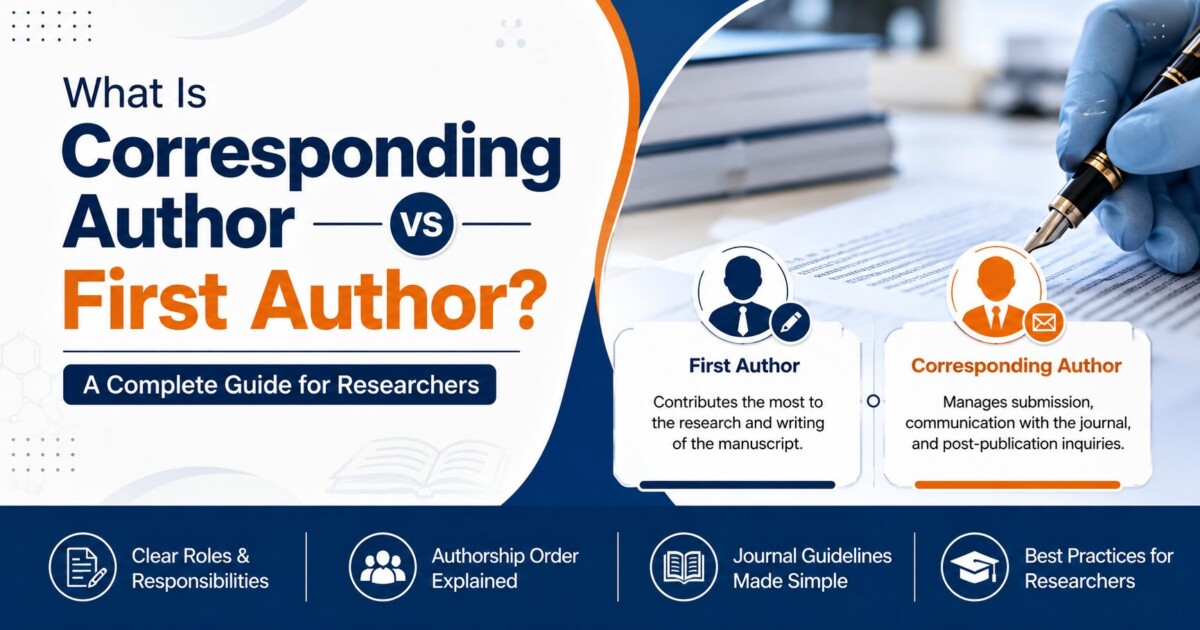
The first author is the researcher who carries out the majority of the actual research work — designing the study, running the experiments, analysing the data, and writing the first draft of the manuscript.
The corresponding author is the person responsible for submitting the manuscript to the journal and managing every piece of communication before, during, and after publication, including peer review comments and reader queries once the paper is live.
These are two separate jobs with two separate sets of responsibilities. A single researcher can hold both titles at once, and in smaller research teams this happens often. But on larger, multi-author studies, the two roles are usually split between different people, and knowing who should hold which title, and why, can genuinely affect how smoothly your paper moves through submission and peer review.
This guide breaks down what each role means, who typically takes it on, how the two positions differ, and how authorship order works across a paper, so you can assign roles on your own manuscript with confidence.
Corresponding Author vs First Author at a Glance
Here is the direct comparison before we go deeper into each role.
| Aspect | First Author | Corresponding Author |
| Primary role | Leads the hands-on research and writes the manuscript | Manages submission and all journal communication |
| Position in the byline | Listed first among the authors | Marked with an asterisk or symbol, email published |
| Typically held by | Junior researcher, PhD student, or the person who did the bulk of the work | Senior author, PI, or whoever the team agrees will handle correspondence |
| Main responsibility window | Study design through drafting and revisions | Submission, peer review, and post-publication queries |
| Career value | Strongest citation credit; the name most associated with the study | Recognised as accountable for the paper’s integrity and data |
| Can it be the same person? | Yes — common on smaller studies and single-author papers | Yes — the corresponding author does not have to be senior or first |
What Is a First Author?
The first author, sometimes called the lead author, is the individual named first in the author list. This position is earned through contribution, not seniority or job title. According to the four core authorship criteria set by the International Committee of Medical Journal Editors, an author must have made a substantial contribution to the work, helped draft or critically revise the manuscript, approved the final version, and agreed to be accountable for the study’s accuracy. The first author is usually the researcher who satisfies these criteria most fully, often a PhD candidate, postdoctoral researcher, or early-career scientist who carried out the study from start to finish.
Role of the First Author
Think of the first author as the person who did the work described in the paper. They are the one who can explain every figure, every dataset, and every methodological decision in detail, because they made most of those decisions themselves.
First Author Responsibilities
- Designing the study alongside the research team and formulating the research question
- Conducting experiments, collecting data, or carrying out surveys, interviews, or fieldwork
- Performing the statistical analysis and building the tables, charts, and figures
- Writing the first complete draft of the manuscript
- Incorporating feedback from co-authors and revising the paper after peer review
- Responding to technical questions the corresponding author forwards from reviewers
Because citations conventionally list only the first author’s surname followed by “et al.” once a paper has three or more authors, this position carries significant weight for grant applications, academic CVs, and promotion or graduation requirements. It is, for good reason, considered the most visible spot on any research paper.
What Is a Corresponding Author?
The corresponding author is the designated point of contact between the research team and the journal. Their name is marked in the published paper, usually with an asterisk or a small icon, and their email address is printed so that editors, reviewers, and readers know exactly who to contact.
This role does not depend on how much experimental work someone did. It depends on who is best placed to manage a process that can stretch across several months, sometimes years, from submission to publication. That is why the position is so often given to a senior researcher or principal investigator with a stable institutional email address and enough publishing experience to handle the editorial back-and-forth.
Role of the Corresponding Author
The corresponding author acts as the project manager of the publication process. Every decision, every revision deadline, and every editorial request passes through this person first, before it reaches the rest of the author team.
Corresponding Author Responsibilities
The duties of a corresponding author generally fall into three distinct stages.
During submission
- Submitting the manuscript through the journal’s online system
- Completing conflict-of-interest declarations, ethics approvals, and copyright forms on behalf of all authors
- Confirming that every listed author has approved the final submitted version
During peer review
- Receiving reviewer comments and editorial decisions and circulating them to the full author team
- Coordinating the revised manuscript and the point-by-point response to reviewers
- Meeting the journal’s resubmission deadlines
After publication
- Acting as the public contact for questions from other researchers
- Handling requests for raw data, methodological detail, or reproducibility checks
- Managing any post-publication corrections, if they ever become necessary
Because this role carries formal accountability for the integrity of the published data, many journals and institutions treat the corresponding author designation as a serious responsibility rather than an honorary title.
First Author vs Corresponding Author: The Key Differences
- Contribution vs contact: first authorship reflects who did the intellectual and physical work; corresponding authorship reflects who manages contact with the journal.
- Timing: the first author’s heaviest workload happens before submission; the corresponding author’s heaviest workload happens during and after submission.
- Seniority: first authorship is earned purely by contribution; corresponding authorship is usually assigned to whoever has the stable affiliation to manage the process long-term.
- Accountability: the corresponding author is specifically the one journals and readers hold answerable for data requests and corrections after publication.
Can the First Author Also Be the Corresponding Author?
Yes. It is entirely normal, and in single-author papers or small two-person teams it is almost always the case, for one researcher to be both the first author and the corresponding author. This happens most often when the lead researcher already has a stable academic email address and enough publishing experience to manage the submission themselves, rather than handing that responsibility to a supervisor.
On larger, multi-author studies, however, the two roles are frequently split. A PhD student might complete the bulk of the work and become the first author, while their supervisor, who has a long-term institutional affiliation and prior experience navigating journal systems, takes on the corresponding author role instead.
Can the Corresponding Author Be the Second Author or Any Other Author?
Yes, and this is one of the most misunderstood points about authorship. The corresponding author does not need to be the first author, the last author, or even a senior author. The role can be assigned to any listed author, based purely on who the team agrees is best suited to manage submission and correspondence. Author order in the byline and the corresponding author designation are two entirely independent decisions, and journals allow teams to arrange both in whichever order fits the study.
Some studies even list more than one corresponding author, particularly in international or multi-institutional collaborations, so that readers in different regions or working in different sub-fields have a direct contact.
Who Should Be the Corresponding Author? How Research Teams Decide
There is no single rule, but most research teams weigh the same handful of factors when deciding:
- Who has the most stable, long-term institutional email address
- Who has previously managed a journal submission and understands the peer review timeline
- Who is best positioned to respond quickly if reviewers or readers raise technical questions
- Who will remain reachable years after publication, since data requests can arrive long after a paper is printed
- Who the full author team agrees should represent the study publicly
Early-career researchers preparing their first submission often benefit from taking on this role themselves once they have stable academic contact details, since it builds direct publishing experience that pays off in future submissions.
Understanding Author Order in a Research Paper
First and corresponding authorship are only two pieces of a larger system. A typical multi-author paper also involves middle authors, co-authors, and a senior or last author, and understanding how all of these fit together avoids most authorship confusion before it starts.
Co-Authors and Equal Contribution
A co-author is anyone who meets the four authorship criteria and contributed meaningfully to the study, whether through data collection, statistical analysis, critical revision, or study design. Middle authors, the names listed between the first and last position, are typically ordered by how much they contributed or, in some fields, alphabetically.
When two or more researchers contributed equally to the leading work, many journals allow a footnote such as “these authors contributed equally to this work.” This is common when two PhD students split the experimental workload evenly, and it protects both researchers’ claim to first authorship in citations and CVs.
Senior Author vs Corresponding Author
The senior author, also called the last author in many disciplines, is usually the principal investigator or lab head who supervised the project, secured funding, and guided the overall direction of the study without necessarily performing the daily experiments. This person is frequently, though not automatically, also the corresponding author, since they typically hold the long-standing institutional affiliation journals look for.
Sometimes one person fills all three roles at once. On larger studies, they are typically three different people, each accountable for a different part of the process.
Corresponding Author vs Co-Author: What Is the Difference?
Every corresponding author is a co-author, but not every co-author is the corresponding author. Co-authorship simply confirms that a person contributed enough to meet the authorship criteria. Corresponding authorship is an additional administrative assignment layered on top of that basic co-author status, given to one person, or occasionally a small named group, to manage the journal relationship.
Real Examples of First Author and Corresponding Author Listings
In a published byline, the structure typically looks like this:
- Ahmed, S., Farooq, M., Khan, A., Rahman, T.* — Ahmed is the first author, and Rahman, marked with the asterisk, is the corresponding author, even though Rahman is listed last.
- Ali, N.*, Siddiqui, H., Malik, F. — Ali is both the first author and the corresponding author, a common setup on smaller studies.
- Chen, L.†, Osei, K.†, Patel, R.* — the dagger symbol (†) signals equal first-author contribution between Chen and Osei, while Patel manages correspondence as the senior author.
The exact symbols vary by journal, but the logic stays the same: position in the list signals contribution ranking, while the special marker signals who to contact.
Authorship Disputes: How They Happen and How to Prevent Them
Authorship disagreements are one of the most common sources of tension in research teams, and they are almost always preventable. Most trace back to one cause: the team never had an explicit conversation about roles before the study began.
The reliable fix is agreeing on authorship order and responsibilities at the planning stage, not after the manuscript is finished. Many groups now use the CRediT (Contributor Roles Taxonomy) framework to record who handled conceptualisation, data curation, formal analysis, writing, and supervision as a living document from day one, giving every contributor documented proof of their role if a dispute ever arises.
Two practices worth avoiding entirely are honorary or gift authorship, adding a respected name despite no real contribution, and ghost authorship, leaving out someone who genuinely did the work. Both violate standard publication ethics guidelines. If authorship does need to change after submission or publication, journals typically require a signed letter from every author explaining the change, following the process outlined by the Committee on Publication Ethics.
Why Getting Authorship Right Matters Before You Submit to a Scopus-Indexed Journal
Author order and the corresponding author designation are not administrative afterthoughts. Editors at Scopus-indexed and other high-impact journals routinely check that authorship declarations are consistent, that every listed author has approved the final manuscript, and that the corresponding author’s contact details are current. Inconsistent or incomplete authorship information is a common, entirely avoidable reason manuscripts get sent back before they even reach peer review.
Working through this decision as part of a wider submission strategy, rather than as a last-minute formality, is exactly the kind of preparation covered in our journal publication support services, where our team helps structure every part of your manuscript, including author contribution statements, before it goes to your target journal.
If you are still deciding on your research direction, methodology, or need broader guidance before you reach the authorship stage, our research consultancy services connect you with subject-specific PhD advisors who have been through this exact process on their own published work.
Frequently Asked Questions
Is the corresponding author better than the first author?
Neither role is objectively “better”; they simply carry different value. The first author gains the strongest citation credit and recognition for hands-on contribution, while the corresponding author gains recognition for accountability and is the name journals and readers contact directly. Many researchers consider both positions equally important on their academic CV, just for different reasons.
Should the corresponding author be the first author?
Not necessarily. It is common on smaller studies, but on larger research teams, the corresponding author is often a senior researcher or principal investigator instead, chosen for their long-term institutional contact details and prior experience managing journal submissions.
Is being a corresponding author a big deal?
Yes, in the sense that it carries real accountability. The corresponding author is formally responsible for confirming that all listed authors approved the manuscript, and for responding to any questions about the data after the paper is published. It is a role built on trust and organisational responsibility rather than a purely honorary title.
Who is considered the corresponding author?
The corresponding author is whichever listed author the research team designates to manage submission, peer review communication, and post-publication queries with the journal. This is usually agreed upon during manuscript preparation and confirmed in the submission system.
Can the corresponding author and first author be different people?
Yes, and on multi-author studies this is extremely common. The first author is chosen based on who contributed the most hands-on work, while the corresponding author is chosen based on who is best positioned to manage the publication process, two separate considerations that frequently point to two different people.
What is the difference between a corresponding author and a co-author?
A co-author is anyone who meets the standard authorship criteria for the study. The corresponding author is one specific co-author given the additional responsibility of managing all communication with the journal. Every corresponding author is a co-author, but only one author (or occasionally a small named group) typically holds the corresponding author title.
Final Thoughts
Understanding the difference between a corresponding author and a first author comes down to one distinction: contribution versus contact. The first author is defined by the depth of their hands-on involvement in the research. The corresponding author is defined by their responsibility for the paper once it enters the journal’s editorial process. Deciding these roles early and communicating openly with your co-authors is the simplest way to avoid disputes and keep your submission moving smoothly toward acceptance.